



BIOWORKS® process
As per definition, waste water is water that has polluted by its use, and therefore cannot be used any longer for its original purpose. Waste water contains several pollutants, solid waste particles as well as many dissolved components such as carbon- and nitrogen compounds and phosphates. These pollutants can also be described as “nutrients”, since smaller lifeforms, such as bacteria or protozea, can feed on them.
The digestion and absorption of these compounds, with the help of suspended bacteria (“the activated sludge”) and with the provision of oxygen is the base of the activated sludge process (ASP), which is the underlying principle for the aerobic biological waste water treatment.
The BIOWORKS®-process is a variant of the ASP, which commonly is known as “low loaded, extended aeration” process. In combination with submerged floating fine bubble aeration with self propelled moveThe BIOWORKS®-process is a variant of the ASP, which commonly is known as “low loaded, extended aeration” process. In combination with submerged floating fine bubble aeration with self propelled movement by the OXIWORKS®-aeration system and its other important feature, the integrated secondary clarifier at the end of the biological treatment step, we have created the BIOWORKS® process.
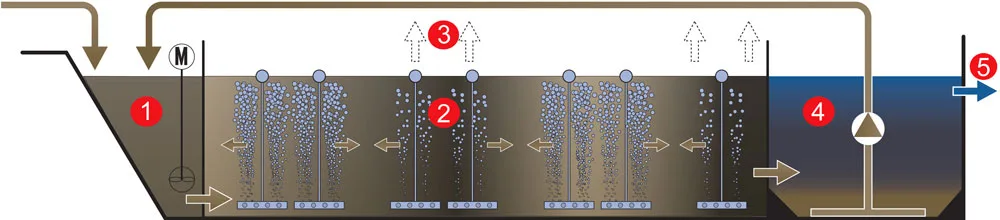
The BIOWORKS®-process starts with the (optional) Bio-P zone (1). Waste water and return sludge (bacteria resp. activated sludge) enter this Bio-P zone. In this “selector basin” and under an anaerobic environment, the bacteria are driven to absorb more phosphates than usually in the following activated sludge stage. Submerged mixers ensure good contact between the activated sludge and the waste water. Effluent values of total P < 1 mg/l without chemical dosage are possible under the condition, that the inflow phosphate levels do not exceed common values.